Your Grandma's Lamp, Reclaimed: The Maximalist Collectors Making Chaos the Hottest Interior Trend in America
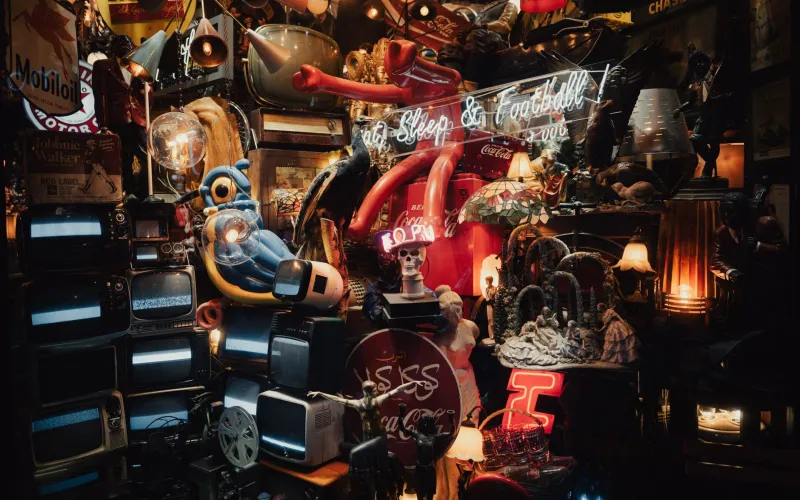
Let's establish something immediately: the living room belonging to Theo and Cassandra, a couple in their early thirties living in a rented rowhouse in Baltimore, contains — at last count — fourteen lamps, a taxidermied peacock named Gerald, three working fondue sets, approximately forty ceramic owls, a vintage Lite-Brite in a gilded frame, and a velvet painting of a matador that they describe, without irony, as "the emotional anchor of the space."
It is, objectively, a lot. It is also, somehow, completely magnificent.
The Death of the Empty Room
For roughly a decade, the dominant visual language of aspirational American interiors was restraint. Neutral palettes. Negative space. A single artful succulent. The Instagram aesthetic that turned "clean lines" into a personality type and convinced an entire generation that the best living room was one that looked like nobody actually lived in it.
That era is, to put it gently, cooked.
What has risen in its place is harder to name and considerably more fun to look at. Anti-minimalism. Maximalism. Cluttercore. Grandmillennial style with a chaotic twist. Whatever you call it, the aesthetic unifying principle is essentially: find the weirdest object in the thrift store, bring it home, and give it a place of honor next to twelve other objects that have absolutely no business being in the same room together.
The people driving this movement are not interior designers in the traditional sense. They are collectors, obsessives, thrift-store archaeologists — people who spend their Saturday mornings at Goodwill and estate sales with the focused intensity of competitive athletes, hunting for the specific kind of strange that cannot be manufactured or ordered from a catalog.
"I'm not decorating," Cassandra explains, gesturing at Gerald the peacock with genuine affection. "I'm curating a world. There's a difference."
The Thrift as Creative Medium
The American thrift store has always been a treasure chest for those willing to dig. But something has shifted in how a particular cohort of young creatives approaches the hunt. Where previous generations shopped secondhand out of necessity or nostalgia, the current wave of maximalist collectors is doing it with a deliberate, almost theoretical intention.
The objects they're after tend to share certain qualities: they are specific, they are strange, they carry the evidence of a previous life, and they are almost always deeply unfashionable by conventional standards. We're talking about avocado-green kitchen appliances from 1974. Macramé wall hangings the size of a dining table. Brass animal figurines of ambiguous purpose. Lamps shaped like things lamps have no business being shaped like — mushrooms, flamingos, abstract blobs that might be coral or might be something else entirely.
The '70s loom particularly large in the maximalist imagination, and not by accident. That decade produced home goods with a commitment to personality that later eras systematically stripped away. A lamp from 1973 has opinions. It takes up space — visually, psychically. It refuses to be background.
"There's something politically satisfying about rescuing this stuff," says Imani, a 28-year-old in Atlanta who has amassed what she calls "an irresponsible number" of vintage kitchen gadgets. "These objects got thrown away because the culture decided they were ugly or embarrassing. Bringing them back is a little bit of a statement about whose taste gets to matter."
TikTok Walked So Gerald the Peacock Could Run
If Instagram was the platform that made minimalism a lifestyle brand, TikTok has become the spiritual home of the maximalist collector. The format is almost perfectly suited to showcasing chaotic interiors — room tours that pan across surfaces crowded with objects, each one with its own backstory. Thrift haul videos where the find of the day is a ceramic rooster of genuinely alarming dimensions. Before-and-after transformations where "before" is a normal room and "after" is a room that appears to be having a very good time.
The numbers are not small. Maximalist interior content regularly pulls millions of views. The comment sections are the most wholesome corners of the internet — people losing their minds over a particularly good lamp, debating the correct placement of a vintage globe, demanding to know the backstory of a suspicious ceramic clown.
But the TikTok visibility has done something interesting beyond just driving views. It has created a community of collectors who share sourcing tips, trade objects, and validate each other's increasingly ambitious acquisitions. The algorithm, usually a flattening force, has in this case helped surface a genuinely diverse range of aesthetic visions — maximalist rooms from across the country that share a philosophy but look nothing alike.
Taxidermy, Kitsch, and the New Status Symbol
The question of status is worth sitting with for a moment, because it illuminates something real about why this movement has the energy it does. For a certain class of aspirational consumer, the minimalist aesthetic was always partly a wealth signal — it takes money to live with very little, to have enough space that you can afford to leave it empty. The maximalist counter-move is, among other things, a class critique in lamp form.
A room full of thrifted weirdness is not cheap to assemble — time and knowledge have real value — but it is assembled from objects that the mainstream market discarded. It celebrates the overlooked. It finds value where the taste industry said there was none. It is, in its own gloriously cluttered way, a rejection of the idea that good taste is something you buy new.
And the taxidermy — yes, there's always taxidermy in these rooms, usually something improbable and definitely named — functions as a kind of punctuation mark. A reminder that the whole thing is also funny. That it's okay to love something because it's ridiculous. That a home can be a joke and a sanctuary simultaneously.
Theo, adjusting Gerald's tail feathers with the care of a museum conservator, puts it simply: "I want my house to feel like a place where things happened. Where things are happening. I don't want it to look like a waiting room."
Gerald, for his part, looks magnificent. Fourteen lamps agree.