Alley Oop: The Rogue Muralists Turning America's Forgotten Backstreets Into the Most Honest Art Spaces on Earth
Alley Oop: The Rogue Muralists Turning America's Forgotten Backstreets Into the Most Honest Art Spaces on Earth
There is a specific kind of alley that exists in almost every American city. You know the one. It smells faintly of last Tuesday. It's decorated with a dumpster, a suspicious stain, and approximately four hundred years of accumulated municipal indifference. Nobody lingers. Nobody photographs it. The city forgets it exists until a pipe bursts.
And then, one morning, it has a thirty-foot painting of a woman made entirely of shattered clocks staring directly into your soul.
Welcome to the alley mural movement — America's most chaotic, most confrontational, and most genuinely thrilling art scene right now. No grants. No gallery representation. No velvet ropes. Just paint, nerve, and the audacity to believe that a crumbling brick wall behind a Buffalo wing restaurant deserves to be beautiful.
The Gallery Is Dead, Long Live the Alley
Let's be honest about what the traditional gallery experience has become. You walk in. Someone offers you warm white wine in a plastic cup. You stare at something small and expensive on a white wall under lighting calibrated to make you feel slightly inadequate. You nod. You leave.
The alley offers something radically different: scale, surprise, and zero pretension. You don't go to an alley mural. You stumble into it. You round a corner in Detroit or Tucson or Richmond and suddenly you're confronted with something so enormous and strange that your brain has to physically recalibrate. That involuntary double-take? That's the whole point. That's the thing galleries charge admission to manufacture and almost never actually achieve.
Muralists working in alley spaces have figured out something the fine art world keeps fumbling: context is everything. A painting in a white cube is a painting. That same image scaled to forty feet on a wall where people actually live, commute, and exist? That's a conversation.
Who's Actually Doing This
The artists driving this movement are a genuinely strange and wonderful mix. Some are formally trained painters who got bored and claustrophobic inside the gallery system. Others are graffiti writers who evolved their practice without ever abandoning the streets. A growing number are complete outsiders — graphic designers, tattoo artists, muralists who taught themselves on YouTube and then immediately went bigger than anyone expected.
What they share is a specific kind of impatience. They don't want to wait for a curator to validate them. They don't want to spend three years applying for the kind of public art grant that requires you to submit a twelve-page proposal and attend a community meeting where someone will inevitably ask if the colors could be a little more neutral.
In cities like Philadelphia, Los Angeles, Kansas City, and Louisville, these artists have quietly built entire ecosystems around the alley as exhibition space. Some work with neighborhood organizations. Some ask forgiveness instead of permission. Most operate in a productive gray zone where the city isn't exactly sanctioning what they're doing but has also quietly decided to stop painting over it because the alternative — a blank wall covered in actual illegal tags — is considerably worse.
The Cities That Get It (And the Ones That Really Don't)
America's relationship with alley murals is, to put it diplomatically, complicated.
Some cities have leaned in hard. Louisville's NuLu neighborhood has essentially built a tourism identity around its alley art corridors. Visitors specifically plan routes through them. Restaurants on those alleys report higher foot traffic. The city, which once treated these walls as liabilities, now quietly takes credit for an arts scene it mostly just got out of the way of.
Chicago's Pilsen neighborhood has a decades-long tradition of politically charged mural-making that has spread into its alleyways with remarkable intensity. Walk the back streets there and you'll find work that's explicitly confrontational — immigration, police violence, displacement, gentrification — all the subjects that polite public art committees prefer to address through the medium of abstract shapes and inoffensive color palettes.
And then there are the cities actively scrubbing. There are municipalities — often in wealthier, more anxious neighborhoods — where property owners have started treating murals as code violations. Where the same city councilperson who gave a speech about supporting local arts will also quietly authorize the power-washing of a wall because a developer complained it clashed with the aesthetic vision for a new luxury condo project. The irony is loud enough to hear from space.
What Makes Alley Art Different
Here's the thing about alley murals that separates them from their more respectable cousins on building facades: they're intimate in a way that public art rarely manages to be.
A mural on a main street performs. It knows it's being seen. It behaves accordingly — tends toward the crowd-pleasing, the civic, the broadly palatable. Alley murals, tucked away from the primary visual real estate of a city, operate under different pressure. They can afford to be weirder. Angrier. More specific. More honest.
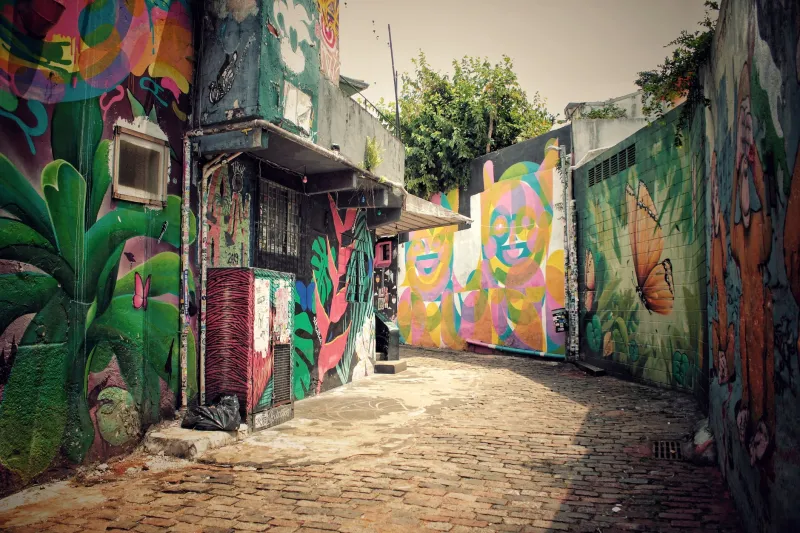
Some of the most striking work happening in American cities right now is in spaces most residents have never visited — narrow passages between buildings, the backs of parking structures, the forgotten walls of industrial blocks that haven't been developed yet because nobody's figured out how to monetize them. Artists are finding these spaces precisely because of their marginality. The neglect is the point. Painting something extraordinary in a place the city forgot is its own kind of argument.
The Gentrification Problem Nobody Wants to Talk About
And yes, we have to talk about it, because it would be dishonest not to: alley murals are complicated by the same forces that complicate everything cool in American cities right now.
Artists revitalize neglected spaces. Those spaces become destinations. Destinations attract attention. Attention attracts development. Development prices out the artists who created the destination in the first place. It's a cycle so predictable it has become a cliché, and yet it keeps happening because cities keep letting it happen.
The muralists working in alley spaces are often acutely aware of this dynamic. Many are deliberately making work that resists the aestheticization of their neighborhoods — work that's too raw, too political, too specific to a community's actual experience to function as a backdrop for a brunch spot's Instagram account. Whether that resistance is ultimately effective is a real question. But the intention matters, and it shows in the work.
Why This Is the Most Exciting Art Scene in America Right Now
Here's the unvarnished take: if you want to understand what American visual culture actually looks like in 2025 — what it's worried about, what it's celebrating, what it refuses to stop saying out loud — you are not going to find it in a Chelsea gallery or an art fair booth. You're going to find it in the alleys.
The alley mural movement is doing what the best art always does: it's meeting people where they are, without asking them to dress up for it. It's using the city's own forgotten infrastructure as a canvas for the conversations the city keeps avoiding. It's loud, it's occasionally overwhelming, and it has absolutely zero interest in your approval.
Which is, honestly, exactly what art is supposed to feel like.
So next time you're cutting through a back street and you round a corner into something that stops you cold — some wild, enormous, inexplicable painting that has no business being this good in this place — take a minute. Someone worked really hard to ambush you with beauty in a place you weren't expecting it.
The least you can do is let it wreck you a little.