Wet Chalk, Dry Wit, and Zero Permission: Inside the Pavement Art Movement Claiming America's Streets One Block at a Time
Wet Chalk, Dry Wit, and Zero Permission: Inside the Pavement Art Movement Claiming America's Streets One Block at a Time
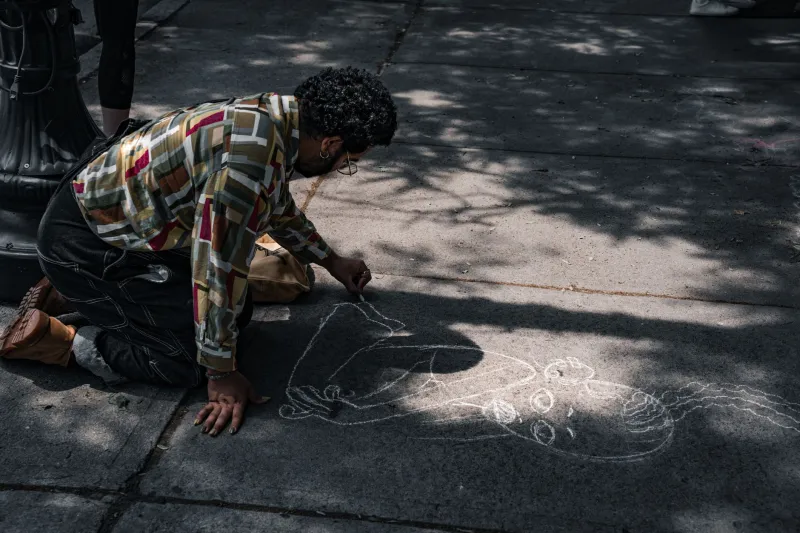
Here's a thing that happened in Pittsburgh last spring: a woman named Deja spent eleven hours on her knees turning a busted stretch of sidewalk near her apartment into an enormous chalk rendering of her late grandmother's face. Neighbors stopped. Kids crouched down to look. One guy cried a little, which he absolutely denied. Then it rained. And just like that, Deja's grandmother dissolved back into the pavement like she was never there.
Deja posted a photo. It got forty thousand shares. She shrugged and bought more chalk.
This is the pavement art movement in a single, soaking-wet nutshell: enormous effort, zero permanence, and somehow more emotionally loaded than half the stuff hanging in museums with $25 admission fees.
The Gallery That Doesn't Card You at the Door
Let's be honest about what most public art actually is. It's a sculpture of a businessman outside a corporate headquarters. It's a mural commissioned by a city council that took eighteen months to approve and ended up being a tasteful swoosh in the municipal color palette. It's art that was designed, above all else, not to bother anyone.
Sidewalk and pavement muralism is the opposite of that. It bothers people constantly, and that's the whole point.
Across the country — in neighborhoods from South Side Chicago to East Los Angeles to a crumbling strip of downtown Tulsa that the city forgot to redevelop — artists are treating public concrete as the most democratic canvas in existence. No gallery application. No artist statement in a font size no human can read. No velvet rope. Just pavement, pigment, and the understanding that whoever walks past this thing next Tuesday is your entire audience.
The medium ranges wildly. Some artists work exclusively in chalk, embracing the impermanence like a philosophical commitment. Others use exterior spray paint or latex rollers, building pieces that survive a few seasons before the sun and the salt and the scooter traffic grind them back to nothing. A growing contingent does both — chalk for sketching, paint for staying — which sounds practical until you realize most of them are doing it without asking anyone's permission first.
The Unspoken Rules (That Everyone Somehow Knows)
For something with no governing body, no official membership, and no group chat that actually stays on topic, the pavement art scene runs on a surprisingly coherent set of unwritten rules.
First: you don't paint over someone else's active piece. Active meaning it's clearly recent, clearly loved, and clearly still being added to. You can work around it. You can respond to it — leave your own piece adjacent, in dialogue, like a visual argument. But you don't just slap your tag across someone's three-day labor of love. That's not edgy. That's just rude.
Second: the neighborhood gets a vote, even if it never formally casts one. Artists who've been doing this for years describe an almost intuitive feedback loop — people stop and watch, people bring you coffee, people tell their kids to come look. Or they don't. The absence of that response is its own kind of critique, and experienced pavement artists pay attention to it.
Third, and this one's important: if the rain comes and takes your piece, you don't get to be weird about it. You knew the deal. The impermanence isn't a bug in the system. It's the entire operating philosophy.
Rain as Curator, Time as Critic
There's a whole conversation to be had about why impermanence hits different when it's literal. Like, everyone nods along when a gallery artist talks about the fleeting nature of beauty or whatever. But when Deja's grandmother actually dissolves in real time because a thunderstorm rolled through — that's not a metaphor anymore. That's just Tuesday.
Some artists have started leaning into the erasure as part of the work itself. A muralist in New Orleans named Terrance documents the decay of each piece he makes — day one, day four, day twelve, day after the first rain — and posts the progression like a time-lapse eulogy. His most-shared post is a video of a massive chalk portrait of a local second-line drummer slowly blurring into abstraction over the course of a week. It has more views than anything in the city's official public art collection. Nobody commissioned it. Nobody paid for the documentation. Terrance just thought it was worth recording.
The impermanence also keeps the gatekeepers out, which is not an accident. When your art is gone in a week, it's very hard for anyone to monetize it, institutionalize it, or slap a corporate sponsor logo on it. The whole ecosystem stays weird and local and human because there's nothing durable enough to sell.
The Rivalries Are Extremely Real
Before you go thinking this is all communal healing and neighborhood harmony, let's talk about the beef.
Because there is beef. There is absolutely beef.
In cities where the scene is dense — Baltimore, Portland, Austin — there are ongoing, deeply personal disputes about territory, about style, about who's doing it for the love and who's doing it for the Instagram. There's a particular kind of tension that emerges when a chalk artist who's been working the same underpass for three years watches a newcomer show up with a sponsored post deal and a ring light. The OGs do not love this.
There's also the thorny question of what happens when the city notices. Some municipalities have started commissioning pavement murals through official channels, which sounds supportive until the artists realize the approval process requires six months, a liability waiver, and art that is, quote, "appropriate for all audiences." Several artists who've navigated this process describe it as watching someone try to domesticate a feral cat — technically possible, deeply unpleasant for everyone involved.
Why It Matters More Than You Think
Here's the thing about art that lives on the street, costs nothing to view, and disappears before anyone can write a Yelp review: it changes how people move through space.
Researchers and urban planners have actually started paying attention to this. Neighborhoods with active informal mural scenes show measurable increases in foot traffic, in the amount of time people spend outside, in the frequency with which strangers make eye contact and do that little acknowledging nod. None of that is earth-shattering on its own. But stack it up across a dozen blocks and a few years and you start to see something that looks like community cohesion, built not by a city initiative with a $400,000 budget but by someone who showed up with a bucket of chalk on a Saturday morning.
Deja is working on a new piece. She won't say what it is yet. She will say that it's going to take two days to finish and that she's already checked the weather forecast.
There's a forty percent chance of rain on Sunday.
She bought extra chalk anyway.