Buzz, Baby, Buzz: Inside the Glowing Obsession Driving America's Neon Sign Collectors Absolutely Feral
Buzz, Baby, Buzz: Inside the Glowing Obsession Driving America's Neon Sign Collectors Absolutely Feral
Let's be honest: most of us have walked past a rusted, half-dark sign dangling off a shuttered diner and thought absolutely nothing. Maybe a flicker of vague nostalgia, maybe just hunger. But then there are the others — the ones who slam the brakes, hop out of their truck, and start negotiating with a confused demolition crew like their entire personality depends on rescuing that buzzing glass relic. These people are neon collectors, and they are, in the most affectionate possible sense, completely unhinged.
Across sun-baked desert lots in New Mexico, cluttered warehouses in Detroit, and meticulously curated garages in rural Tennessee, a fiercely passionate subculture is doing something genuinely radical: treating roadside Americana like fine art. And increasingly, the rest of the world is catching on.
The Hunt Is Half the Religion
Ask any serious collector how they got started and you'll get a story that sounds less like a hobby origin and more like a spiritual calling. Marcus Delray, a 44-year-old former electrician from Tucson, describes the moment he pulled a 1950s motel sign out of a skip bin behind a wrecking yard as "basically a religious experience, except with more tetanus risk."
The chase itself is its own ecosystem. Collectors haunt estate sales, trawl demolition permits filed with city offices, and maintain elaborate networks of tipsters — former sign shop employees, motel owners, small-town historians — who alert them the moment something old and glowing is about to meet a bulldozer. There are Facebook groups with thousands of members that operate like neon-specific intelligence agencies. Someone in Ohio posts a blurry photo of a condemned bowling alley. Within forty minutes, three people have already called dibs and one person is already in their van.
The signs themselves are physical records of commercial America's most visually chaotic era — roughly the 1930s through the 1980s — when every roadside business competed for attention with hand-bent glass tubes, custom typography, and enough electrical voltage to light a small apartment. Motels, diners, liquor stores, laundromats, bowling alleys, car washes: each one commissioned something unique, something local, something that couldn't be replicated with a click-and-ship order from a corporate supplier. That specificity is exactly what makes collectors lose their minds.
Restoration Is Where It Gets Weird (and Beautiful)
Owning a vintage neon sign and having a vintage neon sign are two very different things. Between those two states lies an often months-long process of restoration that borders on obsessive ritual.
Neon tubes, for the uninitiated, are delicate glass structures filled with noble gases — neon for red-orange hues, argon mixed with mercury for blues and greens — that glow when electrified. After decades of exposure to weather, neglect, and the general chaos of American commercial life, most rescued signs arrive in rough shape. Tubes are cracked. Transformers are fried. The original color has faded or shifted entirely. Restoring them requires a specific set of skills that sit somewhere between glassblowing, electrical engineering, and art conservation.
Some collectors do it themselves, learning the craft through YouTube rabbit holes and old trade manuals. Others work with the dwindling number of professional neon benders still operating in the US — a craft that, at its peak, employed tens of thousands and has since contracted to a few hundred dedicated practitioners. Either way, the process is painstaking, expensive, and, according to everyone who does it, completely worth it.
"The first time you flip the switch and a sign you spent four months fixing just comes back," says Delray, "it's like watching something breathe again. I'm not even being dramatic."
He is, a little. But also, he's not.
Why Now? Why This?
Here's the thing that makes the neon revival genuinely interesting rather than just nostalgic: it's happening at peak digital saturation. We live in an era of infinite scroll, algorithmic aesthetics, and screens engineered to keep your eyeballs locked in a dopamine loop. And yet a growing number of people — skewing younger than you'd expect — are obsessing over objects that require physical space, physical maintenance, and produce a warm, slightly imperfect glow that no screen has ever convincingly replicated.
There's a texture to neon that digital can't touch. The slight hum of the transformer. The way the light behaves differently depending on the gas mixture and the glass coating. The fact that each sign was bent by a human hand, which means no two are ever quite identical. In an age of infinite reproducibility, that handmade imperfection hits different.
Instagram and TikTok have, somewhat ironically, accelerated the trend. Neon signs photograph beautifully, and a well-curated garage or warehouse full of glowing vintage signage is catnip for visual platforms. But collectors are quick to point out that the online attention is a side effect, not the point. The point is the object itself — its history, its weight, its weird specific existence as a record of some particular American moment.
Altars, Archives, and a Little Bit of Chaos
What's genuinely moving about the neon collector world — and yes, we're using the word "moving" about people who argue passionately about argon versus krypton fill ratios — is the preservation impulse at its core. These signs are primary documents. They're evidence that a specific town once had a bowling alley called The Lucky Strike Lanes with a hand-lettered logo that some local sign painter spent weeks designing. They're proof that American roadside culture was, for a few glorious decades, a genuinely vernacular art form.
Without collectors, most of it would be landfill. The economics of preservation don't work in neon's favor — the signs are heavy, fragile, expensive to restore, and not exactly prioritized by historical societies with limited budgets. So the collectors step in, motivated by something that's part aesthetic passion, part archival instinct, and part sheer refusal to let beautiful things disappear.
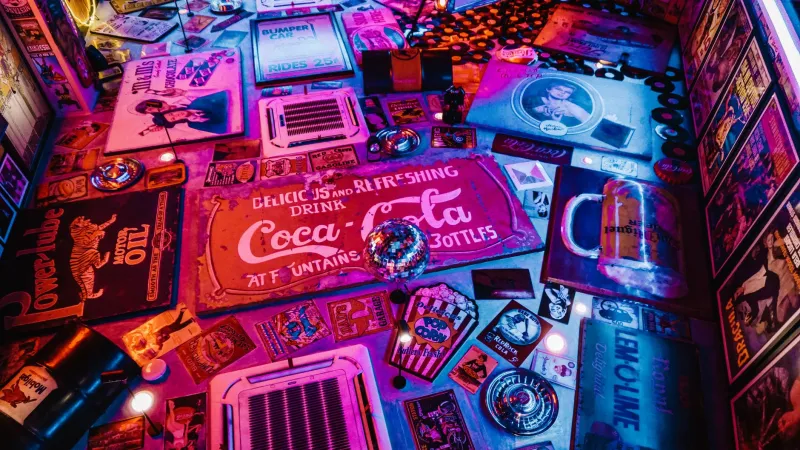
The results can be extraordinary. Walk into the right collector's space and you're inside something that functions like a museum, a shrine, and a very good bar simultaneously. Signs from demolished drive-ins glow next to rescued motel logos from highways that no longer exist. It's American mythology rendered in bent glass and noble gas, humming quietly in someone's garage in the middle of nowhere.
The Glow Doesn't Lie
Neon is having a moment — but the serious collectors will tell you it never really stopped having one. The signs were always out there, waiting in junkyards and storage units and behind dumpsters, holding their shapes, waiting for someone stubborn enough to bring them back.
In a cultural moment defined by ephemerality — trends that live and die in seventy-two hours, aesthetics that cycle through irony and sincerity so fast nobody can keep track — there's something quietly radical about a community that measures its devotion in decades and its trophies in glass. These people are playing a completely different game. And honestly? Their game glows way cooler.
So next time you drive past a shuttered diner with a half-dark sign still clinging to its facade, take a second look. Somewhere out there, someone is already on their way with a van and a very specific dream. The signs aren't dead. They're just waiting.