Pie, Portals & Pure Pandemonium: The American Roadside Diners That Eat Reality for Breakfast
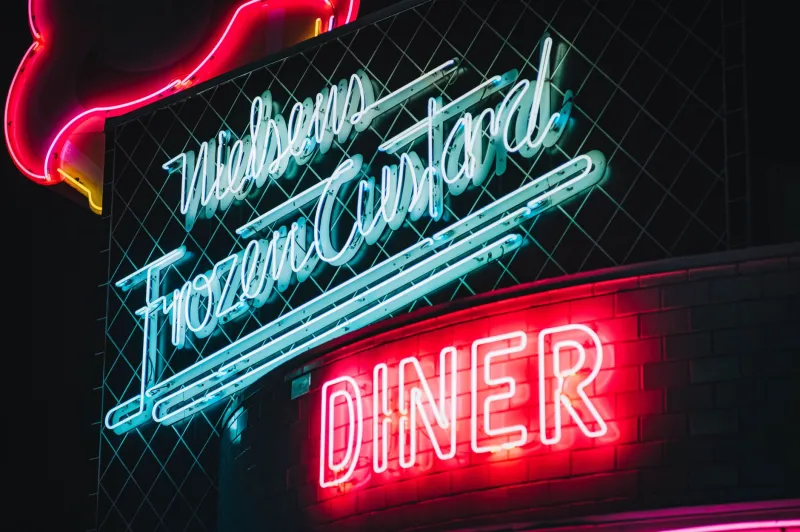
There is a diner somewhere in rural New Mexico where the ceiling is entirely covered in velvet Elvis paintings, the coffee is served in mugs shaped like cowboy boots, and the woman behind the counter — let's call her Darlene, because her name tag says Darlene — will tell you, completely unprompted, that she once saw a UFO land in the parking lot and it ordered the meatloaf special. You will believe her. You will also order the meatloaf special.
This is the American roadside diner at its most evolved form: not just a place to eat, but a place to experience, to question your grip on consensus reality, and to leave with a paper bag of leftovers and a spiritual crisis you didn't budget for. And right now, in a cultural moment drowning in algorithm-optimized aesthetics and Instagram-perfect brunch spots, these maximalist temples of weirdness are having an absolutely unhinged renaissance.
Why Normal Restaurants Are Boring and These Places Are Not
Let's be real: the average dining experience in 2024 is a carefully curated sensory neutralization exercise. Exposed brick. Edison bulbs. A menu that uses the word "artisanal" four times. You know what you're getting before you even sit down, and that's precisely the problem.
The cult-favorite roadside diner operates on an entirely different frequency. These are places built by people who had a vision — sometimes a very specific vision, sometimes a vision that arrived at 3am — and then executed it with zero concern for what the Yelp demographic might think. The result is an eating environment that feels less like a restaurant and more like climbing inside someone's brain during a particularly productive hallucination.
And Gen Z, a generation that grew up in the most visually homogenized era in human history, is obsessed.
"People drive four hours to come here," says Rick Terraneau, owner of The Mothership Diner in Marfa, Texas, a legendary roadside institution where the walls are plastered floor-to-ceiling with vintage sci-fi paperback covers, every booth is a different color of aggressively wrong, and the menu features items like the "Roswell Ranchero" and a dessert listed only as "The Incident." "They show up, they sit down, they look around, and they go completely quiet for like thirty seconds. That silence is my favorite thing. That's the moment they realize this place is real."
It is real. Deliriously, gloriously, stubbornly real.
The Taxonomy of Unhinged: What Makes a Diner a Portal
Not every weird diner achieves portal status. There's a difference between a place that hung some quirky signs and a place that has genuinely bent the fabric of spacetime in the service of the breakfast burrito. The real ones share a few key characteristics.
Maximalism that means something. At The Mermaid Café in Eureka, California — a Pacific Coast institution that has been operating since 1974 — the entire interior is a deep-sea fantasy executed with the commitment of a person who has never once doubted a single decision. Fishing nets drape from the ceiling. Antique diving helmets sit on every surface. A mural of an octopus consuming a pirate ship spans the entire back wall. Owner Patrice Holloway, who inherited the diner from her mother and has added to its collection for thirty years, describes the design philosophy simply: "More. Always more. The ocean doesn't do minimalism and neither do I."
Menus that require a moment. The legendary Pie Hole Universe in Asheville, North Carolina — a diner that has been described by multiple travel writers as "what would happen if a carnival and a philosophy department had a child" — offers a menu structured not by food category but by "emotional state." Feeling existential? Try the Void Omelette (black bean, squid ink, topped with what the menu calls "a sprinkle of acceptance"). Feeling chaotic? The Tornado Skillet involves seventeen ingredients and arrives at the table still technically on fire. "The menu is a conversation starter," says co-owner Jerome Vásquez. "We want people to have to make decisions about who they are before they eat."
Staff who are part of the atmosphere. This is the secret ingredient most food critics miss. The great weird diners don't just hire servers — they attract characters. People who have been there for twenty years and know things. People who will sit down across from you uninvited and tell you about the time the county fair came through in 1987 and something strange happened with the funnel cake. This is not a performance. This is just what happens when a place develops a genuine soul.
The Road Trip as Ritual
What's fascinating about the current diner pilgrimage phenomenon is how intentional it's become. People aren't stumbling into these places — they're planning cross-country routes specifically around them. TikTok accounts dedicated to roadside diner hunting have accumulated millions of followers. Subreddits devoted to "liminal diners" and "American weird food spaces" have become surprisingly active communities.
"There's something about the physical journey that matters," says cultural writer and self-described diner obsessive Tamara Osei, who has visited over sixty roadside diners across twenty states in the past three years. "You can look at photos online all you want, but you can't smell the Mothership Diner from your phone. You can't feel what it's like to walk into the Mermaid Café on a foggy Tuesday morning when there are only two other people there. These places are experiential in a way that resists documentation. That's actually rare now. That's actually precious."
She's right, and it points to something deeper than nostalgia or novelty-seeking. In an era where almost every experience has been pre-filtered, pre-reviewed, and pre-optimized for shareability, these diners represent something genuinely resistant to the content machine. You can post about them, sure — and people do, endlessly — but the post never quite captures it. The weirdness is irreducibly there, in the physical space, in the specific light, in the particular angle of a taxidermy deer wearing sunglasses that you didn't notice until your third visit.
America's Most Underrated Art Form Is Apparently a Ham and Cheese Omelette
Here's the argument, stated plainly: the American roadside diner — at its most chaotic, most maximalist, most completely unhinged — is one of the country's most authentic art forms. It's folk art you can eat in. It's an installation that serves coffee. It's a decades-long creative project undertaken by someone who probably never once called themselves an artist.
The Smithsonian has entire wings dedicated to less culturally significant things.
The next time you're planning a road trip, do yourself a favor: skip the chain restaurant with the predictable menu and the inoffensive décor. Find the diner that shows up on three different "weirdest places in America" lists and has a Yelp review that just says "I don't know what happened but I feel different now." Drive there. Sit in the strangest booth. Order the thing on the menu that confuses you most.
Let Darlene tell you about the UFO.
Order the meatloaf special.
You're welcome.