Holy Wax: The Delightfully Unhinged Religion of America's Record Store Die-Hards
Holy Wax: The Delightfully Unhinged Religion of America's Record Store Die-Hards
Let's get one thing straight: nobody needs to buy vinyl anymore. Spotify exists. Apple Music exists. You could, right now, listen to every recorded piece of music in human history while sitting on your couch in your underwear eating cereal at 2 p.m. on a Tuesday. The technology is there. The infrastructure is flawless. The price is approximately the cost of one medium latte per month.
And yet — and yet — every Saturday morning across America, grown adults wake up early, drive to a small, often financially precarious shop that smells like old cardboard and ambition, and spend hours flipping through physical discs of compressed plastic, occasionally holding one up to a fluorescent light like a doctor inspecting an X-ray, before paying $34 for something they could have streamed for free.
This is not a niche hobby. This is a calling.
The Crate as Cathedral
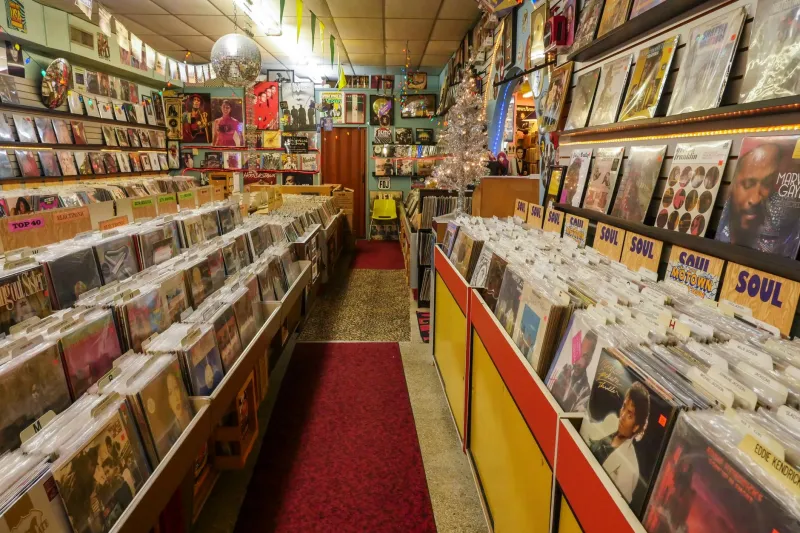
Walk into any serious independent record store in America — Amoeba in Los Angeles, Reckless Records in Chicago, Waterloo Records in Austin, or the thousand smaller, scrappier shops tucked between laundromats and bodegas in cities nobody's writing travel guides about — and you'll feel it immediately. There's a particular energy in these places. A reverence. People speak in hushed tones, or not at all. Eyes stay down, fixed on the rows of spines. The only acceptable interruption is when someone pulls out a record and wordlessly holds it up to a friend, who nods or shakes their head with the gravity of a Supreme Court justice.
These aren't shoppers. These are worshippers.
"I've had customers come in here on their lunch breaks three times a week for fifteen years," says Marcus, a clerk at a beloved shop in Philadelphia who asked us not to use the store's name because, and we quote, "we don't really want more people knowing about us." That sentence alone tells you everything about the culture. "Some of them don't even buy anything. They just need to be here. They need to flip through the crates. It calms them down. It's like therapy, but cheaper and with better music."
The Hierarchy Is Real and It Is Ruthless
Make no mistake: record store culture has a social ladder, and it is steep, and it is judged with a ferocity that would make a medieval guild blush.
At the top sits the Lifer — usually a person of indeterminate age who has been coming to this specific store since before you were born, knows where every record lives, has opinions about mastering that could fill a dissertation, and will say nothing to you directly but will absolutely sigh audibly if you put something back in the wrong section. The Lifer does not explain themselves. The Lifer simply is.
Below them: the Specialists. These are the jazz people, the soul people, the krautrock people, the hyper-specific sub-genre devotees who have narrowed their entire collecting focus to, say, Brazilian funk records pressed between 1971 and 1974, and who will happily talk at you about this for forty-five minutes if you make the mistake of making eye contact.
Then there are the Enthusiasts — the newer converts, still buying everything, still figuring out what their thing is, still making rookie mistakes like buying a record without checking the condition of the vinyl first. They are tolerated. They are occasionally mentored. They are never, ever allowed to forget the time they asked if the store carried Taylor Swift on vinyl.
(They do, by the way. It sells extremely well. Nobody talks about this openly.)
The Holy Grail Is Different for Everyone, Which Is the Point
Ask any serious collector about their best find and watch their entire face change. The jaw loosens. The eyes go somewhere else. They are no longer in this room with you — they are back in that moment, in that specific crate, in that specific shop, pulling out the thing they'd been hunting for years.
For Denise, a 38-year-old librarian in Portland, Oregon, it was an original pressing of Joni Mitchell's Court and Spark she found for $4 in a Goodwill in rural Idaho on a road trip she almost didn't take. "I cried in the parking lot," she says, completely without embarrassment. "My friend thought I was having a breakdown. I was, technically. A good one."
For Jerome, a 22-year-old in Atlanta who got into vinyl during the pandemic and has since spent what he describes as "a genuinely alarming amount of money" on records, the grail isn't even a specific album — it's the feeling of not knowing what's in the next crate. "Streaming killed the surprise," he says. "On Spotify, the algorithm already knows what I want before I do. In here, I have no idea what's gonna be in the next section. That uncertainty is the whole point. I'm addicted to not knowing."
This is, perhaps, the most honest thing anyone has ever said about why vinyl culture refuses to die: it is fundamentally, stubbornly, joyfully inefficient, and in a world optimized to the point of sterility, inefficiency has become its own form of luxury.
The Clerks Are the Keepers of the Flame
No profile of record store culture is complete without acknowledging the clergy: the clerks. These are people who, in many cases, possess knowledge that would be genuinely impressive in any field, deployed in service of a job that pays approximately nothing. They have heard everything. They have opinions about everything. They will share those opinions whether you asked or not, and somehow this is not annoying — it is, in fact, exactly why you're here.
"People don't come in just to buy records," says Tanya, who has worked at a shop in Seattle for nine years and radiates the calm authority of someone who has seen it all and judged most of it. "They come in to be told what to listen to by someone who actually cares. The algorithm recommends you stuff. We tell you what you need to hear. There's a difference."
There is a difference. And apparently, it's worth driving across town for.
Why This Matters (And Why It's Absolutely Insane That It Does)
Here's the wild part: vinyl sales in the US have been climbing for seventeen consecutive years. In 2023, Americans spent more money on vinyl records than on CDs for the first time since the 1980s. The format that was supposed to be dead — that was dead, clinically, for about a decade — has staged a comeback so improbable it reads like fiction.
The record store, against all reasonable expectation, is not a relic. It's a refuge. A place where the music isn't just heard but handled, where the artwork is actually large enough to look at, where the act of choosing what to listen to requires physical effort and human interaction and the occasional argument about whether the original pressing really does sound better than the reissue (it does, and don't let anyone tell you otherwise).
In an age of infinite access and zero friction, these places are selling friction. They're selling limitation. They're selling the beautiful, maddening, completely unnecessary experience of working for it.
And people, bless them, are absolutely buying in.
The church of wax is open on Saturdays. Dress code is whatever. Bring cash.